A Language in Motion: Pallay in Patacancha Valley
Brisa Ocampo | Storytelling Coordinator at Awamaki | 17th of August 2026.
“Our designs are like a book,” Jesusa Quispe told me during an interview in Patacancha. As she ran her fingers across the motifs woven into her lliqlla — a large woven mantle traditionally used to carry children, food, and everyday belongings — she did not describe patterns. She summoned memories.
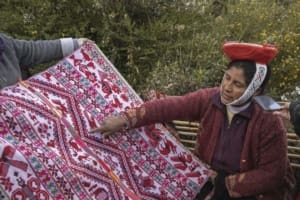
Jesusa had woven this lliqlla when she was around nineteen or twenty years old. She no longer remembers the exact year, but she remembers the river. She points to a woven line that curves along one side of the mantle: the Patacancha River, the river beside which she grew up. Around it, she composed the world she knew and the moments she wanted to preserve. There are hummingbirds woven as a pair, flowers she remembers finding along the paths near her home, a condor, a duck from the lagoon, and a parrot she saw flying above Patacancha during the season when flocks migrate toward Quillabamba. There is also a guitar, woven because at that time she liked to sing and her husband — who was then her boyfriend — played it.
The textile does not simply depict the landscape around her. It holds a version of Jesusa herself: a young woman beside a river, noticing the plants and animals around her, remembering migrating birds, and weaving the relationships that shaped that moment in her life.
None of this is decoration in the ordinary sense. Jesusa’s lliqlla functions almost like a diary made of wool: a record of a particular place, time, and way of seeing. It also offers a way into understanding pallay, the Andean weaving practice through which designs emerge by selecting and lifting warp threads. In Quechua, pallay refers to both this technical process and to the motifs created through it.
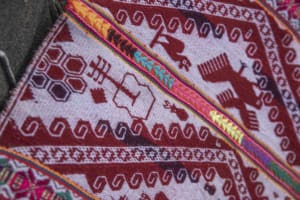
Jesusa’s lliqlla reveals one way in which pallay carries memory. Across the Andes, textiles have long shaped social, economic, and ceremonial worlds; in Patacancha Valley, they also serve as a way of remembering. Motifs of animals, plants, landscapes, and everyday experiences form a visual language through which weavers express relationships to place, community, and personal history.
Yet pallay is not a fixed collection of symbols with one meaning. Designs emerge from different layers of knowledge: what a weaver has seen, what she has learned from others, what has been inherited from previous generations, and what she chooses to transform. Can a living tradition ever be fully defined?
In Patacancha, a highland community near Ollantaytambo in Peru’s Sacred Valley, pallay continues to be shaped by the women who practice it. Drawing on conversations with weavers from Patacancha and Huilloc, field observations, and Awamaki’s collaboration with local weaving cooperatives, this explores how woven motifs carry memory, how knowledge is transmitted across generations, and how pallay continues to change through shifting materials, markets, and aspirations across the valley.
A Shared Tradition, Different Communities
The Patacancha Valley lies above Ollantaytambo in Peru’s Sacred Valley. While Ollantaytambo functions as a commercial and transit town, the surrounding highland communities are shaped by everyday life rooted in local traditions sustained across generations. Within this valley are the communities of Huilloc, Patacancha, and Kelqanka, each shaped by its own altitude, landscape, and relationship with the town: Huilloc lies closest to Ollantaytambo, Patacancha in the middle of the valley, and Kelqanka higher in the mountains.
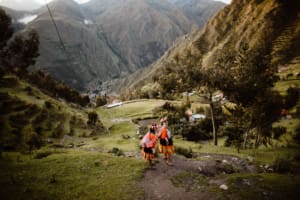
These geographic differences are reflected in textile practices, although weaving traditions across the valley remain closely connected and recognizable to one another. For weavers from Patacancha, color is one of the most immediate ways to express this distinction. Women from Songuillay Cooperative describe red, orange, white, yellow, and green as characteristic colors of their textiles, while neighboring communities create different combinations and tonal balances. Differences also appear in composition: Patacancha textiles are often recognized for larger, more open motifs, while communities such as Huilloc tend to weave smaller and denser designs.
Yet these distinctions are not only visual. They also reveal how each community carries its own histories, landscapes, and ways of understanding the world through weaving.
Beyond Decoration: Memory, Biography and Meaning
Jesusa’s lliqlla shows one way in which pallay carries memory: through personal experiences woven into a landscape. For other women in Patacancha, memory appears through inherited designs, sacred animals, historical figures, and techniques learned from previous generations.
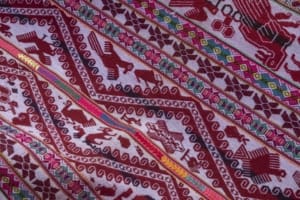
At first glance, pallay may appear to be a collection of decorative motifs. Yet for the women who weave them, these designs function as a form of communication. Textile scholar José Ruiz Durand[1] argues that Andean iconography operates as a visual language: a structured system of signs and symbols through which knowledge, relationships, and ideas are expressed. Rather than isolated images, motifs acquire meaning through their connections to one another and to the cultural worlds from which they emerge.
Weavers in Patacancha often describe this process not in abstract terms, but through the act of remembering while they weave. In an interview with Sabina Riquelme from Awaq Puña Cooperative, she speaks of how motifs emerge from different layers of experience. This includes what she sees, what she practices, and what she has learned from others. Alongside animals such as ducks, horses and butterflies, she weaves wallatas (Andean geese), which carry a particular personal and sacred meaning for her, much like llamas. Both are also present in local dance traditions, linking the textile to forms of movement and celebration beyond weaving itself.
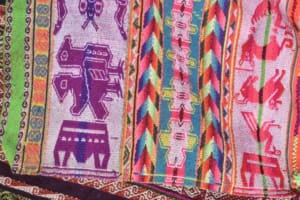
Other motifs reveal another way that knowledge travels. Boats, for instance, are not part of Sabina’s immediate environment, but she learned to weave them from her mother. Their presence in her textiles does not come from direct observation, but from family transmission: a design vocabulary inherited across generations before a weaver decides how to arrange and combine it with her own experiences.
This process of learning and composing extends into more complex stages of weaving practice. Sabina describes one important milestone in this process: the ability to weave the image of Túpac Amaru II being drawn by four horses, a composition that demands precision, spatial control, and mastery of multiple weaving techniques. The motif is widely recognized across Patacancha textiles and continues to circulate as a symbol of Quechua resistance and historical memory.
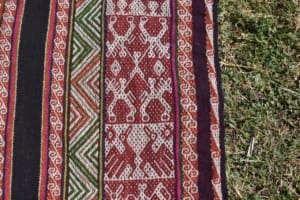
Túpac Amaru II was a descendant of the Inca nobility from the Cusco region who led one of the largest uprisings against Spanish colonial rule in the Andes during the eighteenth century. Captured and executed by colonial authorities in 1781, his figure has remained a powerful symbol of resistance and Indigenous memory across many Andean communities. In Patacancha, this history continues to be carried through textiles, not as a distant historical event, but as a story woven into designs learned across generations.
In conversations with Reyna and Juliana from Awaq Puña Cooperative, the meaning of this motif emerged as inseparable from the story of Túpac Amaru II’s execution. They explained that they continue to weave him because he was pulled apart by four horses. The simplicity of this explanation does not reflect a lack of meaning; rather, it reveals how certain histories are already deeply embedded within the community.
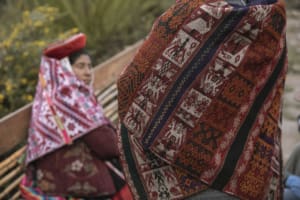
Jesusa’s own lliqlla carries this historical reference in another form through the image of a white horse, a motif she learned from her mother and continues to reproduce through her own weaving practice. Through pallay, historical memory is not preserved as a fixed image, but carried through fragments — a horse, a figure, a name — that each generation learns to recognize and reinterpret.
But even within these shared forms and shared stages of learning, no two textiles are the same. The vocabulary of pallay may be transmitted across generations, and certain motifs may be widely recognized, but each weaver brings her own way of combining, remembering, and composing them in space.
Geometry, Relationship, and Visual Meaning
The meanings carried by pallay do not exist only in individual motifs, but also in the relationships created between them. During conversations with weavers from Awaq Puña Cooperative, several women pointed to motifs that are intentionally organized in pairs. Hummingbirds often appear facing one another, while floral motifs may simultaneously represent the visible flower above the ground and the tuber growing beneath it. Rather than functioning as separate images, these elements gain meaning through their placement and relationship to one another.
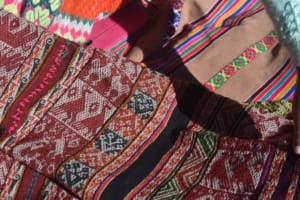
This way of composing resonates with textile scholar José Ruiz Durand’s interpretation of Andean visual systems, in which meaning emerges not from isolated motifs but from the connections between them. Pairs, contrasts, symmetry, and repetition are not simply compositional devices; they are part of a broader visual logic through which relationships are expressed.
Seen in this light, pallay communicates not only through what it depicts, but through how those elements are arranged. The organization of motifs expresses relationships between above and below, one figure and another, and people and landscape. Meaning does not reside in individual images alone, but in the connections that allow them to become part of a larger visual language.
A Living Tradition: New colors, new materials
Jesusa remembers the materials her mother worked with when she was a child. At that time, she says, mantles and skirts were made from hand-spun sheep wool in a limited palette of white, grey, black, and red. Today, synthetic yarns are widely used in everyday weaving because they are easier to obtain, require less preparation, and offer a much wider range of colors, including bright greens, pinks, and purples that were not part of previous generations’ palettes. Jesusa describes this transformation with ambivalence: the new materials make weaving more accessible, but they also represent a departure from the practices she learned from her mother.
These changes have transformed the visual appearance of textiles across the valley, while older combinations — such as reds, yellows, and darker tones associated with traditional garments — continue to hold cultural significance. Rather than replacing previous palettes, new colors have become part of an expanding visual vocabulary through which weavers negotiate continuity and change.
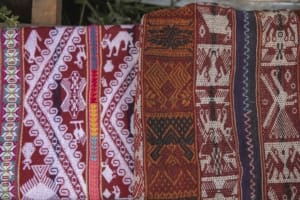
The arrival of new materials has also been accompanied by changes in weaving techniques. Natural fibres continue to hold value, particularly in pieces made for sale, where alpaca and sheep wool are associated with authenticity and higher prices. At Awaq Puña Cooperative, Reyna, Sabina, and Juliana describe another transformation within weaving itself: the emergence of techniques such as chullanka, a newer style characterized by a single-faced design used to cover larger sections of a mantle. For them, innovation is not separate from tradition; it is another stage in the way weaving knowledge develops.
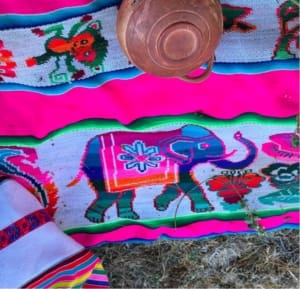
These transformations are also visible in the motifs that appear in contemporary textiles. Alongside condors, llamas, rivers, and flowers, some weavers now incorporate lions, elephants, and other animals encountered through television, photographs, travel, or exchange with outside markets. These additions do not necessarily replace older designs; rather, they demonstrate how pallay continues to expand as weavers incorporate new references into an existing visual language.
A textile’s story, however, does not end when it leaves the loom. Sabina explains that many younger weavers keep their lliqllas for around three years before selling them to visitors. Reyna follows a similar practice and currently keeps five, while Juliana chooses not to sell hers, preserving them despite the economic value they could bring. Some textiles remain within families because of the memories attached to them: Jesusa, for example, still keeps a mantle inherited from her mother-in-law because of the particular style and history it carries.
Through its collaboration with local weaving cooperatives, Awamaki supports weavers in bringing these traditions into contemporary markets while continuing to value the techniques and knowledge behind each piece. For many women, this work provides an additional source of income while allowing them to share their weaving practices beyond the valley.
What the future looks like from here
At the same time, perspectives on the future of weaving vary across the valley. In Patacancha, weaving is still something many girls want to learn. Women describe how children grow up watching their mothers and grandmothers weave, often beginning to practice from an early age, and continuing to develop their skills alongside school life.
In Huilloc, which is closer to Ollantaytambo, several weavers describe a different reality. In an interview with Herminia and Constantina from Kusi Qoyllur Cooperative, they explain that many young people are now pursuing secondary education, university studies, and work opportunities outside the community. As a result, fewer girls are choosing to continue weaving in the same way, and the practice is becoming less central in everyday life. As they reflected, weaving is increasingly seen as something difficult to sustain alongside new aspirations.
These differences suggest that proximity to the town, access to education, and migration shape how weaving is learned and valued. Rather than moving in a single direction, textile traditions are unfolding differently across the valley – more actively preserved in some communities, and more fragile in others.
In Patacancha, pallay is not something preserved outside of time, but something practised within it. It exists in the way motifs are selected and combined as they are woven, in the materials that shift with availability and use, and in the changing paths of the women who learn and continue this practice.
What is recorded through conversations and documentation with local weaving cooperatives is only part of the story. What remains is the act itself – the continuous making of meaning through weaving, where memory, place, and experience are held together each time a textile is brought into being.
References
[1] [1]Ruiz, J. (2002). Introducción a la Iconografía Andina