Re-thinking Relationships: Reflections on MEG Annual Conference 2026
Olly DeHerrera | Graduate of Visual, Material and Museum Anthropology at Wolfson College, Oxford | 20th July 2026.
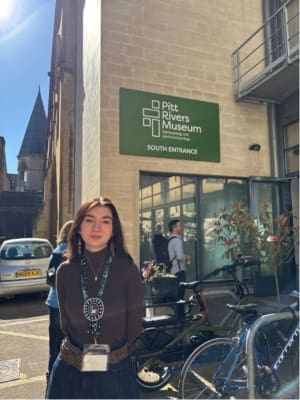
A couple of months ago, I was delighted to attend the MEG Annual Conference as a first-time conference attendee and presenter. It felt very fitting to deliver my first conference paper at the same place where I completed my Masters in Museum Anthropology and fell in love with collections and their possibilities. As I spent two years discovering, the Pitt Rivers is a fascinating place to study the curious phenomena of the museum.
Hosted by the team of the Re-thinking Relationships project, the conference explored how relationality is navigated practically and theoretically through collections-based collaborations. Presenters brought a variety of creative reflections to this theme, covering personal and institutional considerations, insights into ongoing projects. We all had the privilege of hearing from a range of projects and institutions, stretching across five continents.
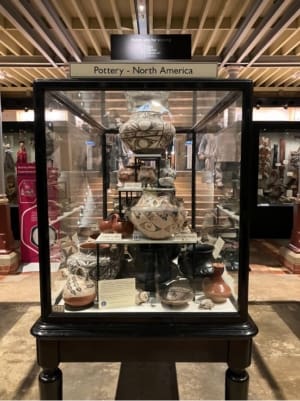
As a recent graduate, this conference offered a unique opportunity to present the research undertaken during my postgraduate studies. My own background in the Indigenous American Southwest motivates me to tell objects’ stories in a way which centres Indigenous narrative and honours the cultural keepers who have imparted this knowledge to me. My paper, entitled: ‘An arrowhead can leave anytime it wants’: Indigenous strategies for object collaborations, advocated for the acknowledgment of objects as research participants in museum anthropology. Centering discussion on the contents of the ‘Pottery – North America’ case at the forecourt of the Pitt Rivers Museum, I sought to emphasise the agency of the pottery as is understood by their Indigenous source-communities back home in the high desert of New Mexico and Arizona.
The Journey to my first conference paper
The pottery I hoped to introduce (or re-introduce) to conference attendees stands in the forecourt of the Pitt Rivers museum. Pottery of this kind has played a prominent role in exchanges that characterised colonial interactions in the Southwestern United States.
In recent years, the ongoing interpersonal interactions between Indigenous people and ancestral Puebloan pottery have been explored through numerous large scale community-curated exhibits, including the Metropolitan Museum of Art’s Grounded in Clay (2023), and the Museum of International Folk Art’s I am Clay (2026). Such exhibits have actively restored the language of kinship, teaching and survival to the curation of Pueblo pottery.
Building upon this growing willingness to platform Indigenous knowledge and narrative, my paper intended to explore how an approach of ‘collaboration’ within an anthropological framework can honour ancestral objects by affording them the status of research partners. The title of my paper evolved from a simple but compelling idea I encountered during my undergraduate fieldwork in the Ute Mountain Ute Tribal Park. While perusing the ancient pottery, clay pipes, baskets, and ancestral corn seeds that animate our ancestral places, my guide shared the teaching “An arrowhead can leave anytime it wants, you can put one in your pocket just to find it is gone when you get home”. I chose to invoke this teaching to highlight how the acknowledgment of object agency may upend much of the postcolonial discourse surrounding museum’s ownership of Indigenous material culture.
The process of decolonising collections is not straightforward, and collaborating with Indigenous perspective will often involve an inherent reframing of the museum as a space. My paper sought to highlight how this process will invariably invoke challenging questions, including exploring what possible insights could be achieved if we reframe objects as consenting anthropological participants. This is not to say that this is the only way of viewing the North American Pottery collection at the Pitt Rivers, but it is my hope that my paper inspired those in attendance to reflect on their relationship with institutionalized objects they encounter.
Conference Reflections
The packed conference schedule provided the opportunity for valuable discussion with other practitioners on their own experience of collaborations with Indigenous source-communities. As well as hearing papers from fellow Indigenous researchers sharing their methods for improving the visibility of traditional knowledge.
Through two workshops, we had the special opportunity to explore questions of museum ethnography through hands-on engagement with objects from the Pitt Rivers’ collection. Courtney Joseph’s Relational Object’s workshop took us back to the ‘basics’ of emotional engagement with the collections, reminding us that the museum is a space of emotion, reaction and collective care. Anthony S. Kalume hosted an exploration of East African objects in a creative Performance as Enquiry workshop, taking us through an interactive wedding ceremony typical of his community.
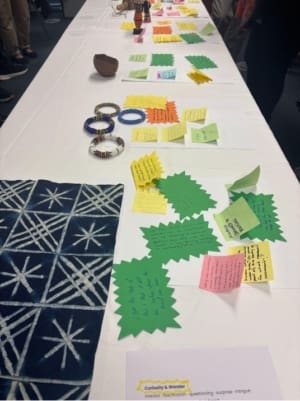
These sessions provided a wonderful platform to engage with collections as a focal point for exploring the museum’s archives. I appreciated the open space these workshops created for people to openly share their raw reactions to the material, transforming the space into a place for discussion and shared enthusiasm for collections. A reminder of the almost endless possibilities embedded within material culture.
Attending the conference renewed my belief that the museum is a place for everyone to be heard. In the face of so much uncertainty in the sector, it was refreshing to meet staff, practitioners, and academics working around the globe to keep collections accessible.I want to thank MEG for their conference bursary, allowing me to present my research and gain so much from the people I met. I am sure I will look back on this conference as a significant step in my career journey!