Artecampo Museum: An interview with Alejandra Rueda on October 27th, 2025
Isabel Collazos Gottret | Postgraduate Researcher in Museum Studies, University of Leicester | 10th February 2026.
Artecampo museum of Lowlands Originario and Popular Arts is part of a social change project. Said project began in mid 1980s in Santa Cruz de la Sierra, Bolivia with the aim to improve the lives of rural women through the production and sale of crafts. Indigeneity plays an important but complex role in Artecampo. Most artisans have Indigenous heritage, but not all identify as such. The crafts produced are a combination of Indigenous material culture, commercial craft adaptations and popular crafts.
Vania Alejandra Rueda Cañizares is Artecampo Museum’s coordinator since 2022. She has degrees in political sciences and economics, and a Master’s in ‘Democratic Governance and Civil Society’ from Osnabrück University (Germany). Her dissertation, Decolonising alterity in Bolivia: form mestizo to ch’ixi, led her back to Bolivia to pursue, up-close, her reflections on the continuities and transformations of colonial processes, mainly in the Bolivian Lowlands.
Isabel Collazos Gottret is a Postgraduate Researcher in Museum Studies at the University of Leicester. Artecampo Museum is one of her case studies in her research project: Defining decolonisation in Bolivian museums: from rhetoric and practices to conceptualisation. In October 2025, Isabel sat with Alejandra to discuss the unique potential of Artecampo Museum.
Isabel:
I’d like to talk about what makes Artecampo museum stand out. First, there’s the direct relation that the museum has with the people who produce, who have created the objects in the museum, and who are in some ways the subject of the museum.
Alejandra:
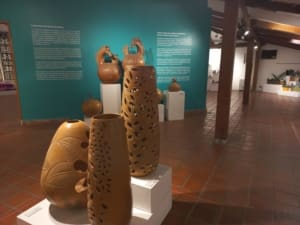
We have the privilege of sharing a physical space. The museum is next to the offices where the artisans arrive to deliver their crafts [for sale] and that multiplies encounters. We’re physically close with the people who made the objects of the collection in the first place and they can interpret them. But it’s not just about museum knowledge. There are so many interactions happening. For example, the arrival of a ceramist from one Guarani community may coincide with that of a weaver from another Guarani community and that intracultural encounter would hardly be possible otherwise. And these things happen through the everyday practices of both Artecampo and the museum.
An artisan might arrive with her production, and she’ll see a group visiting the museum garden with Ernesto, the guide. The artisans don’t go really, to the museum, so how do they think about it? She might wonder, what are these people looking for in the museum? Maybe she’ll question us too, how are we talking about her? Recently, we organised visits with the artisans. There was Don Alberto, an Ayoreo woodcarver, very introverted, he had been silent during most meetings. But, when the visit arrived at the Ayoreo gallery, he said “OK, I’m ready. Come on, ask me, ask anything you like”. I was fascinated by his attitude.
The museum greatly benefits from interacting with the artisans. It’s fascinating for the public to attend the workshops they facilitate, and the encounters where they share their experiences. But I also think that Artecampo, the artisans and organisation, benefits by having the museum nearby. In the present context, Artecampo resources are minimal and the main priority is to sell the crafts. It could become another commercial initiative without the embedded social and cultural aspects unique to Artecampo. The museum also represents the memory of the project through its history and thereby makes the project accountable to its original aims.
Isabel:
It’s interesting because the museum is a witness of the different facets of the artisan’s lives and it’s good that it’s aware of this richness. Can you talk more about the question of knowledge and how museum knowledge intersects with memory and knowledge transmission?
Alejandra:
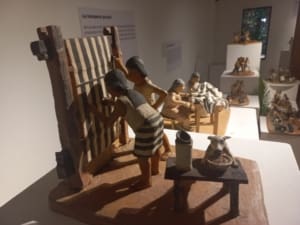
First, there’s the question of documentation. We don’t have a lot of information about how the collection was made and, as individuals, we are limited by what we can interpret from the objects. So, to understand them, we need to go towards the artisans and the Artecampo workers, and we realised that there is so much knowledge around us, just floating about. It’s there when the [craft] production is delivered, and that means that Kate, the production coordinator, can read the objects and their colours in a unique way.
We have the enormous advantage that we can still listen to the people who produce and know these objects. I think that any museum would die to have the chance to have their objects read and interpreted by the very people who produced them. And there’s so much more potential. Because, beyond the collection, we have the archives, the photographs and the means to propose interpretations that are more conversations than monologues. I was very happy to develop the three weaving technique booklets in two languages: Spanish and the Indigenous language the technique is related to. The aim is that the Ayoreo booklet, for example, will someday be read by the sons and daughters of the artisans.
It’s not just about the production of knowledge for the museum, but how that also changes the way the artisans see their work. For example, Isabel Urazayegua, hammock-weaver of Guarayo, went to a documentation workshop organised by ICOM in 2024. When they began to ask questions that went beyond the process, like its origins and transformations, she didn’t have an answer. She became interested in this history so she took back to her village photographs from the museum archive which are representative of the craft group she’s part of, Ko Ore Porav+k+. She wants to be able to show people that her group, the objects they produce, they have a history. Documentation becomes meaningful to the artisans.

Isabel:
The experiences of these artisans show how material culture, its transmission and meanings are also the affair of individuals. Collective practices are not just reproduced homogenously or linearly. The individual paths, abilities and aims within each group make it a living practice too.
The last thing I want to talk about is the role of raw materials within the museum. First, there’s the luscious garden with the garabatá (type of aloe), the jipijapa (palm tree), and the native cotton tree. And now, you’ve also built a clay oven to fire the ceramics produced in the museum workshops. How do these materials and processes influence the narratives and practices?
Alejandra:
It’s certainly an environment that makes us look at craft production from many levels. The garden is fascinating, but at some point I took it for granted. That is until I visited the jipijapa crop the Buenavista artisans are planting and I became fascinated again. How do these plants survive in this environment? And it’s also good because they’re not static objects, they’re alive. You have to relate and care for them because, if you don’t, they won’t just hang around. It’s a similar situation with the oven. We maintain it ourselves, so next week we’re going to strengthen its walls.
We learn, through experience, to not take the materials for granted. Nothing is forever. When I started, we talked about the garabatá in the garden focusing on the Ayoreo techniques. The complex process to transform the fibres into yarn. But then, we saw how the Ayoreo artisans arrived with smaller bags to sell, or they wanted to produce the bags with different fibres, but Artecampo does not receive them if they’re not made from garabatá. The artisans told us that garabatá is harder to find. This puts things into perspective for us, because we are witnessing how this common cultural practice is at a risk of disappearing. So now, when we talk about the garabatá with the museum visitors, we connect them to the impact of deforestation, forest-fires and the expansion of the agricultural frontier. And then, well, the tour might be less pleasant but we’re transmitting a part of reality that is vital.