From Darien to Twickenham: Reconstructing Historical Memory through Phototextile Artefacts
JC Candanedo | Artist in Residency at Orleans House Gallery, London | 7th January 2026.
When I began my artist residency at Orleans House Gallery in Twickenham, in South West London, my plan was to explore how the botanical dyes of the Americas have shaped the material and cultural legacy of European empires. What I did not anticipate was how deeply intertwined the gallery’s own history would be with my birth country of Panama.
My practice of phototextile artefacts has long explored how botanical materials carry historical memory. How plants and fibres can hold traces of colonial extraction, displacement, and ecological impact. During the residency, I began to see my process not only as an act of making but also as a form of reading and interpreting archives.
Early in my residency, I learned that James Johnston, who built Orleans House in the early 18th century, had direct ties to the Darien Scheme, a failed Scottish attempt to colonise part of what is now Panama. As Secretary of State for Scotland, Johnston supported the creation of the Company of Scotland Trading to Africa and the Indies, which aimed to establish a trading post on the Isthmus of Darien and turn Scotland into a global mercantile power.
The colony called New Caledonia was established in 1698 but quickly collapsed due to disease, poor conditions, and political isolation. By 1700, most of the settlers had perished, and the economic loss helped push Scotland into the 1707 Union with England.
When I found myself working in the same building whose early owner had been part of an empire-building plan to colonise my country, I felt compelled to share these findings with the gallery. Alas, they didn’t have much information about the Darien Scheme because the original archive of Orleans House does not reside in Twickenham.
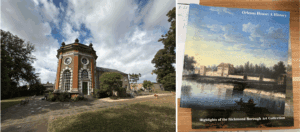
In the nineteenth century, Henri, duc d’Aumale, son of King Louis Philippe of France and former resident of the house, removed the library and papers to Château de Chantilly, where they remain today. The absence of a complete archive at Orleans House forced me to contact other collections such as the British Library and the National Library of Scotland. The layers of connection between the house and the history of my country felt too urgent to ignore.
This experience made me reflect on what we, as artists, can bring to the table when we work with archives. Which stories are invisible to others that are evident to us? What remains hidden? How can our artistic responses mirror these archival journeys?
In my practice, I combine an early photographic process developed in the 19th century called cyanotype with botanical dyes such as logwood and brazilwood. The botanical materials that I use were extracted from the Americas during European colonisation, eventually becoming global commodities and cultural agents. Their extraction drove British settlement in Central America, which relied on the enslavement of both Indigenous and African labour, while reshaping ecosystems, and disrupting ecological knowledge.
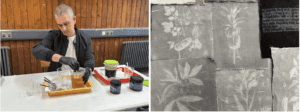
Cyanotypes use ferric salts exposed to light to produce a deep Prussian blue image. Anna Atkins famously used it to record specimens of algae, creating what is considered the first photographic book in history in 1843. However, Anna’s husband’s family wealth came from sugar plantations in Jamaica, a reminder of how photography was entangled with the colonial project.
When I introduce tannin-rich plant dyes into the process, a chemical interaction occurs: iron-tannin complexes shift Prussian blue into deep reds, purples and blacks. This combination allows me to reclaim and reframe both processes: to slow them down, to reconnect with the material origins of colour, and to reflect on how image-making can move from documenting nature to collaborating with it.
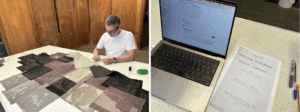
The daily rhythm of my residency became a kind of laboratory of reflection. I spent days in a slow process of scouring and mordanting fabrics, exposing cyanotypes to UV light, and toning them with plant dyes. The transformation of colour became a form of repair, an act of remembrance. A way to honour people, lands, and ecosystems marked by colonial extraction.
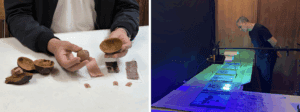
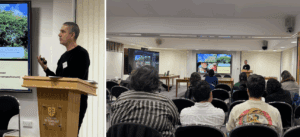
These reflections continued when I presented my work at the “Learning and Making: Weaving Climate, Water, Land, and Communities” Symposium at St Edmund Hall, University of Oxford, in which artists and academics explored how material practice can reshape our relationship with land and water.
During the symposium, I spoke about how botanical dyes, such as logwood, act as cultural agents, embodying both colonial histories and ecological transformation. Through cyanotype and natural dye processes, I reflected on how making can become a method for repairing relationships between humans, plants, and place.
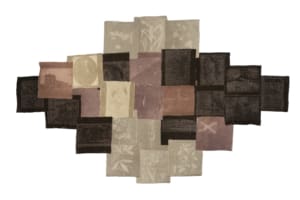
My first artistic response to the residency at Orleans House is Memoirs of Darien, a phototextile artefact that brings together research, making, and reflection. It’s both a visual and material archive that references the failed Scottish colony and the enduring legacy of the botanical heritage from the American continent.
This residency has taught me that an archive does not have to be whole to be meaningful. Sometimes, its power lies precisely in what is missing, in what sparks our curiosity to look elsewhere and to listen to the materials themselves. The loss of the original library at Orleans House became a reminder that when engaging with history we don’t see the whole picture, and that inviting artists to work with archives can offer a valuable perspective shaped by material engagement and artistic process.