Studying Indonesian daggers (keris) in UK museums
Fiona Asokacitta | DPhil Candidate, Anthropology Green Templeton College, University of Oxford | 10th December 2025.
I’m a DPhil candidate of Anthropology at the University of Oxford studying collections of traditional Indonesian daggers – kerises – in the collections of five museums across the UK. Growing up in Jakarta, Indonesia, I have observed how central the keris is to national identity. Awarded UNESCO intangible heritage status in 2005, the keris is a dagger originating from the island of Java, approximately some time in the 14th century. Since then, the dagger has spread across Southeast Asia, with unique keris cultures appearing throughout the Indonesian archipelago as well as the present-day nations of Malaysia, Singapore, Philippines, Brunei, and Thailand.
The keris is identifiable through two main physical characteristics, its asymmetric blade shape, and the pamor on the blade, often compared to damascening, but is a distinct style of pattern welding. There are thousands of permutations of the keris, each shifting the dagger’s meaning and societal significance. From the patterns of the pamor, the style of the greneng (the ‘teeth-like’ tail on the heel of the blade), the style of the hilt, and of course, the type of sheath accompanying it, keris morphology has been a particular favourite among Asian hoplologists.
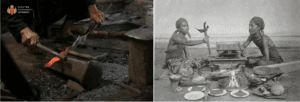
My research examines keris collecting in the UK, and how they reflect over four centuries of Anglo-Indonesian history. Since Indonesia was only a ‘formal’ colony for five years during the Napoleonic Wars in 1811-1816, this shared history has often been underrepresented. However, the collections speak to a persistent entanglement, with the earliest kerises entering the Tradescant collection, now in the Ashmolean Museum sometime in the 17th century.
Due to the overwhelming number of kerises spread across museums in the UK, I have selected five museums as case studies, each with different collecting aims and display modes. These are: the Ashmolean Museum and the Pitt Rivers Museum in Oxford, the National Army Museum and the British Museum in London, and Windsor Castle. Beyond studying the individual kerises in these collections, I am studying how the same ‘type’ of object’s interpretation and ontological status are transformed through being in different types of collections and institutions.
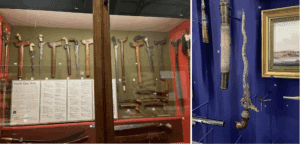
But why study the keris? Despite its ubiquity in Indonesian society today, and its frequent appearance as a political gift between male politicians, it appears relatively rarely in daily life. Unlike batik fabrics, which are now incorporated in both traditional wear and contemporary fashion design, or even the gamelan orchestra, which often features in large gatherings, cultural showcases, or tourist shows, the keris is often the domain of ‘tosan aji’ (sacred iron) enthusiasts, typically populated by middle-aged men. Otherwise, the keris is most relevant in historic regions of keris making, such as Yogyakarta and Surakarta in Central Java, where the traditional courts of Indonesia still maintain some of the most revered keris collections in the world.
As a young female scholar from Indonesia, my research has been met with surprise and enthusiasm from other Indonesians. It is unusual to have women studying the keris, even though there have been female keris smiths, collectors, and owners, but this is rare. The keris has strong phallic associations, from local stories about its origin from a phallus, to its role as patrimony, inherited from the father.
The keris is also a legitimising source of power, bestowed upon male rulers of historic courts across the archipelago. The keris performs this role today, exemplified by the Dutch restitution of Indonesian national hero Prince Diponegoro’s keris in 2020. The repatriation was highly praised in Indonesia (despite some controversy about its authenticity) and symbolised a redress of military humiliation under Dutch colonisation.
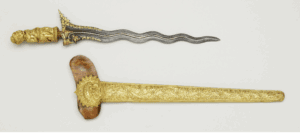
I have been struck by the enthusiasm among Indonesians when I share my topic of research. Many of them, both at home and abroad, seem to always know someone or someone who knows someone who is a keris collector, is an ‘expert’ on the keris, or simply owned one. Similarly common are the questions and/or stories about the keris’ ‘supernatural’ aspects. I have now heard countless stories from various Indonesians and even non-Indonesians about their encounters with keris which are ‘berisi’ (literally translates to ‘filled’). Some kerises are understood to have spirit dwellers, causing the keris to move, fly, disappear, and sometimes attack on its own behest.
My research seeks to incorporate and represent the spiritual nature of the keris, which I view as one pillar of decolonising its scholarship. When reviewing existing keris scholarship, spirituality has always been a difficult subject to discuss, for both Western and Indonesian/Malay scholars. Western scholars until the mid-20th century have tended to exoticize this aspect of the keris, rendering it a fetish object. Furthermore, 19th century scholarship on the keris, perpetuated the perception of the keris as a relic of the Hindu-Buddhist kingdoms of Indonesia, a salvaged remnant of a golden age before Islam.
Unfortunately, most local texts on the keris have not survived, but the scholarship which emerged in the mid-20th century onwards have tended to deemphasize spirituality in favour of ‘empiricism’, or on the other hand, have reintegrated its spirituality within local Islamic belief. As a move to decolonise, many Western scholars since the mid-20th century have tended to also deemphasize the spiritual nature of the keris, which I see as counterproductive.
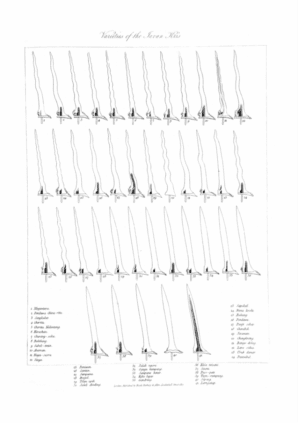
A truly decolonised scholarship on the keris respects and incorporates local resonances and practices as well as the agency of the object. We can do so without automatically assuming that spirituality inherently renders an object ‘merely’ a ‘fetish’. Emphasising the keris’ spirituality does not necessarily freeze the keris as an ancient Hindu-Buddhist relic, excised from contemporary Indonesian society. The keris, just like culture and practice in Indonesian society today, is hybrid, fluid, and syncretic. It is a window into how Indonesians across the archipelago have been able to adapt an ancient craft and object into their complex belief systems throughout the centuries.