The Sensational Museum: Senses and Accessibility
Prof Hannah Thompson | Project Lead of the Sensational Museum | 12th March 2026.
The Sensational Museum (TSM) was a research project funded by the UK Arts and Humanities Research Council (AHRC). In this blogpost, project lead Hannah Thompson explores how the resources developed during the project are helping museums think differently about the objects in their care.
Museum objects are usually displayed in glass cases. This means that an object’s non-visual sensory properties (how heavy it is, what it sounds like, whether it has a distinctive smell) are usually inaccessible to museum visitors. When these sensory properties are central to the artefact’s story, this kind of ocular-centric museum presentation often fails to do justice to the object’s history.
This used to be the case with the Moche pots displayed at the University of Cambridge’s Museum of Archaeology and Anthropology. These striking Peruvian artefacts are most notable for the realistic animal noises they make when filled with water. But no one could appreciate these noises when they were behind glass. We developed an installation called ‘Sensing the Past of Peru’. A group of disabled and non-disabled co-creators used our multisensory interpretation toolkit to find creative, inclusive ways to give visitors greater access to the pot.
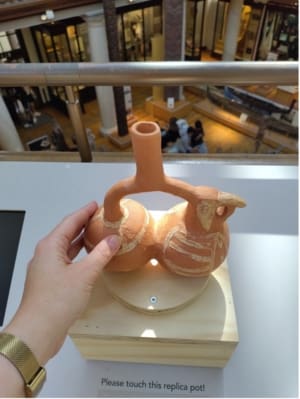
We also created a video showing the curator manipulating the pot. The video includes an audio description created by the co-creation group using the W-ICAD model (Workshop for Inclusive Co-Created AD). Audio description is an integral part of the video: it is the soundtrack, the captions and what the BSL interpreter translates. As it is played in a loop within the galley, the tool is transformed from a marginalised access feature to an integral part of the object’s display and interpretation. It is taken seriously as part of the curatorial process and supports every visitor’s engagement with the object.
The display has large-print text with high contrast, braille labels, and a braille transcript. It also includes an audio recording of the noise made by the pot. The sound the pot makes is a key part of this experience. So, it was important to us that it was also accessible to d/Deaf people. As such, we created a text description of the sound:
“When Jimena moves the pot quickly back and forth, it makes a short, staccato whistle as if a macaw is doing short hooting calls. When she moves the pot in a long smooth motion, it makes one long whistle. If you couldn’t see the pot, you would think it was a bird calling.”
We gave the BSL interpreter both this description and the sound itself and asked her to create her own BSL interpretation. It was important to us that someone who understands how BSL describes sound was involved in creating this sonic description.
Not only does the installation make the pot accessible to people who cannot see it, but it also uses access features traditionally designed for specific groups to make the pots more accessible to everyone. Disability thus becomes a productive source of multi-sensory interpretation.
As well as designing tools that enable co-creators and museum professionals to make their museums more accessible to a wide range of audiences, The Sensational Museum has also developed a Multisensory Collections Management Demonstrator. This showcases an innovative person-centred approach to artefact documentation where museum professionals are encouraged to think about their objects in relation to 10 sensory experiences. Alongside the five familiar senses, we include balance, temperature, pain and the body’s internal and external awareness.
These 10 senses are defined and explained in our Sensory Thinking Guides. We want our users to experiment with evaluative and evocative ways of recording information. Evaluative description captures the sensory content of the collections from a ‘third-person’ perspective, whereas evocative description captures ‘first-person’ experiences of the senses. This page shows one user’s evocative engagement with the Moche pot.
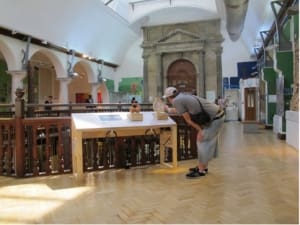
Object records become both more meaningful and more inclusive when they contain rich sensory information. At first, the collections management staff at our pilot museums struggled to relinquish the objective approach they had been taught during training. Nonetheless, once they understood that subjective information enhances the more traditional objective data that they usually record, they were enthusiastic about this immersive new way of gathering and recording information. This approach is particularly effective when dealing with objects, such as the Moche pot, which had profound embodied significance for their original creators. The Sensational Museum’s multi-sensory approach thus represents a crucial means of capturing an object’s authenticity.
The Sensational Museum resources and tools are open access and free to use. Visit our website to explore them.