Helen Anderson (Project Curator, British Museum), 14th January 2019.
As a project curator in the Africa department at the British Museum, I have the pleasure of working on varied and interesting assignments. Over the past six months or so my focus has been identifying and cataloguing photographs attributed to the Nigerian photographer Jonathan Adagogo Green, dating to the late 19th/early 20th century of the Niger Delta. Green ran his own studio in Bonny in the Niger Delta in 1891 until his early death in 1905 at 32 years old, and whose photographs became highly collectible by Europeans and Nigerians alike.
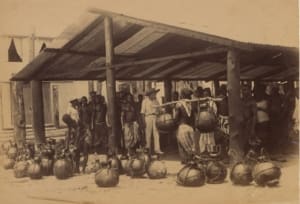
This photograph (one of Green’s) shows a European trader purchasing palm oil in a market in the Niger Delta, taken during the last decade of the 19th century and part of an album owned by a British palm oil trader. The major production of palm oil lay in the interior of the Niger Delta, and oil was traded along the rivers to the ports on the coast where traders were based. The relationship between European traders in the ports and the Urhobo (or Sobo) peoples of the hinterland who produced the palm oil was mediated by local middlemen of the Delta region, the Itsekiri, some of whom became very wealthy.
It is not always easy to understand the relationships between traders and local peoples in the Delta from the albums alone, but in the course of my research it has been possible to discover the identities and background of the owners of these albums, with surprising results. Palm oil traders could often live and work in the Niger Delta for many years, and their ongoing relationships with the Itsekiri went well beyond the economic. The stories uncovered so far show that some traders formed intimate relationships with local Itsekiri women, having children with them and, in some cases, engaging in complex sets of social and cultural relationships with local chiefs, even marrying their daughters.
Photographs can reveal a huge amount of information concerning the types of images people were collecting, the names of commercial photographers and how the same images can recur in different albums over periods of time. They demonstrate details of life for local peoples, European traders and colonial administrators. What they conceal are the specificities, the minutiae of how a palm oil trader from Liverpool marries an Itsekiri princess; what did it mean to be a child of mixed race parents in early 20th century Nigeria; to what extent did photograph albums act as a proxy for diaries, many traders never wrote down their experiences. Our photographic collections are a valuable resource to think about the multifaceted histories and narratives at play in the Niger Delta during this complex period in history, using the camera lens as a prism through which to view these dynamic relationships.